

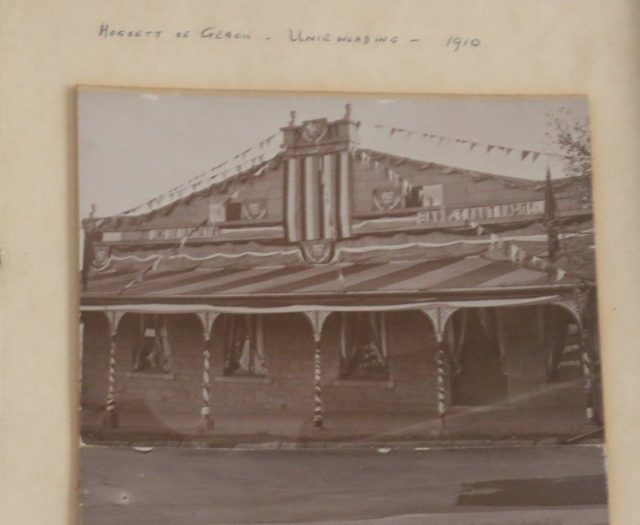
A couple of weeks ago, The Rep asked whether anyone knew more about the history of the building which is home to the Anderson Museum in Dordrecht.
Charlotte van der Berg of Dordrecht did some investigation and with the help of locals, came up with some interesting information on the Hogsett building (which is shown above) which is now home to the museum:
“The Hogsett building was erected in 1903 by William Trimel Hogsett as a shop, using sandstone from the area. He later became the mayor from Dordrecht for many years. A dam was build in the Kloof, and it was named after him. He and his wife Kate were later put to rest in the local cemetery.
On 20 April 1940, the building was sold to the Dutch Reformed Church for 800 pounds. They altered and restored the building according to their needs.
Later part of the building was rented to a Mr Combrink for a coffee shop. Later on Mr G Cloete also rented a part of the building, and manufactured the first soda water in town. In the local museum, there is still a perfect example of the glass bottle which was sealed off by a glass marble.
During 1958, the church had the wish to erect their own building, for which they acquired two erven.
During their 25th celebration in the second half of 1964, the first sod was turned at the new church, and they moved after the building was completed.
However, they decided to keep on renting the building out.
At one stage, it was a Shell garage with the petrol pumps in Grey Street. It was rented to Mr Da Silva and van Rensburg from Aliwal North as a Ford dealer, with Koos du Preez as the manager. He later on took the garage over from them together with his son Koos Junior.
During the 1970s, the OVK Co-op had their grain store in the building. Various other shops also rented parts of the building.
In 1978 Frieda Philipina Anderson who grew up in the area, bought the building with the aim to utilize the building and erf as the Anderson Memorial Museum for furniture and documents of herself and her family, as well as for other people. She was a world wide traveler, and eventually went to London for health reasons. She returned many years later to Dordrecht, and cared for her three sisters. She passed on in 1983, and her family started to get the museum going.
A committee comprising of Sandy Stretton, Cecil Wiehahn, Alan Bradfield, Koba Brits, Barbara Cloete, Jakkie de Klerk, Piet Geyer and Marie Henning steered the project. The museum was opened on 26 October 1984 by her sister’s very well known son, dr LAPA Munnik. Munnik grew up on the farm Driefontein just outside Dordrecht, and became an excellent medical doctor in town. He farmed part time, and later became involved in the politics, and occupied various Ministerial posts. His brother was Judge from the Cape, George Munnik, also stayed on the neighboring farm Bothashoek. (The opening was covered in the Rep 2.11.1984).
The museum however never received any subsidies from the state, and still remain a private museum.
Quite a number of well preserved photo’s of San paintings from the area are on display, as are some stone artefacts. A number of dinosaur fossils have been found in the district, and a copy of one of the fossils are on display. Some fossils have been taken to a number of argeological universities to be cleaned up and be further researched. Just outside town some fossilized trees have been found, and some specimens are also on display.”
Thank you for the information. If you have any interesting historical bits from your area – Ilinge, Sterkstroom, Tarkastad, Hofmeyr, Molteno, Cofimvaba, Cacadu, Cathcart and Jamestown, please let us know! Contact The Rep on sonjar@tisoblackstar.co.za.


